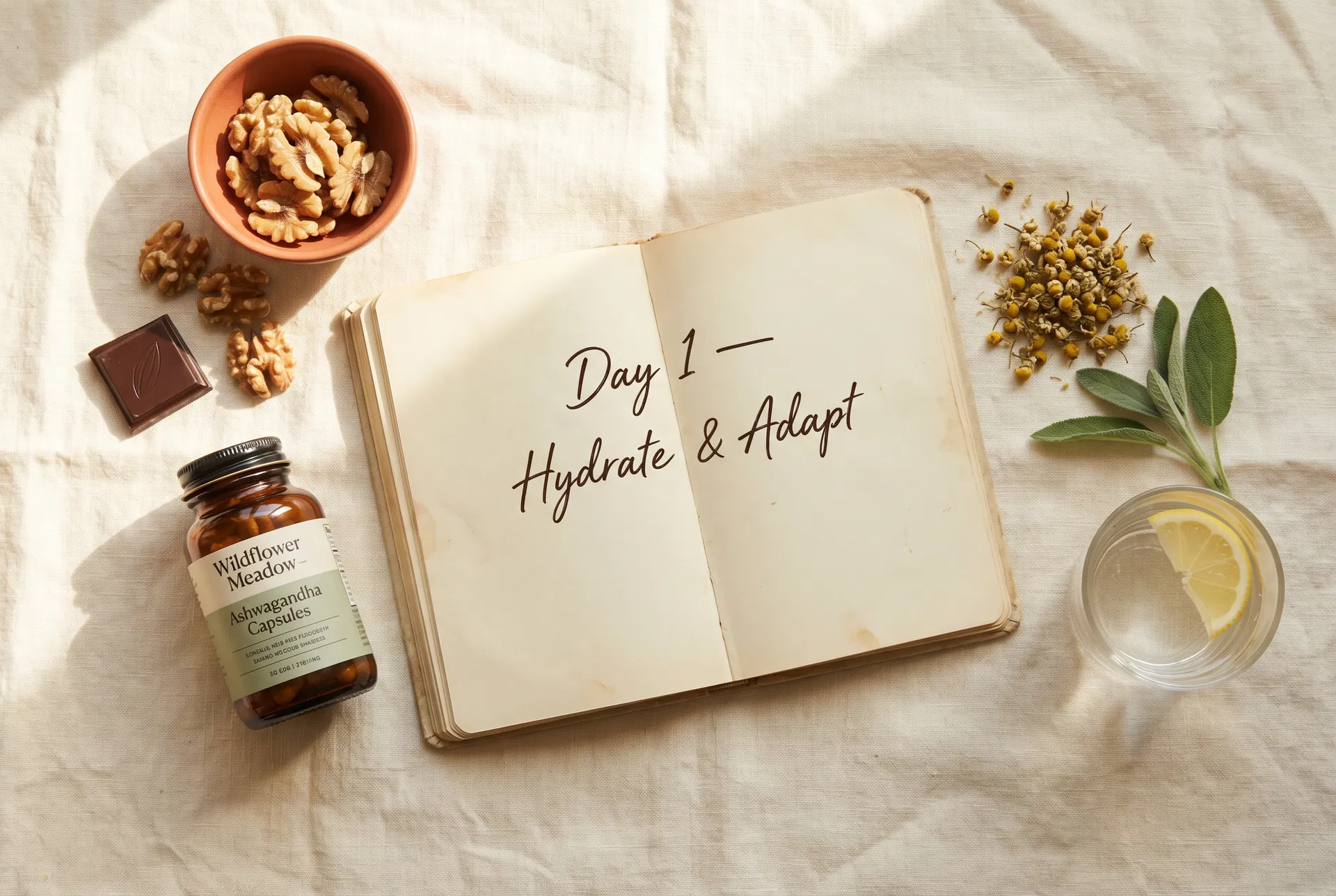
How to Reset Your Cortisol in 7 Days: A Day-by-Day Guide
A practical, day-by-day protocol for lowering cortisol naturally in one week — covering food, supplements, sleep, and nervous system regulation. Written by a woman who's been there.
Cortisol is not a slow-moving hormone. It responds to your environment within minutes — which means the right inputs, applied consistently over seven days, can produce measurable changes in how you feel, sleep, and carry weight around your midsection. This is not a cure. It is a reset: a structured week designed to interrupt the chronic cortisol cycle that most perimenopausal women are stuck in without realising it.
I developed this protocol after spending months reading the research on HPA axis regulation, testing different approaches on myself, and tracking what actually moved the needle. The seven days below are not arbitrary. Each day builds on the last, targeting a different cortisol driver in sequence so your nervous system has time to adapt rather than being overwhelmed all at once.
Before You Start: What to Track
Before Day 1, take five minutes to note your baseline on three markers: your sleep quality (1–10), your belly bloating (1–10), and your afternoon energy crash severity (1–10). Write these in a journal or use the tracking sheet included in the 7-Day Cortisol Belly Reset PDF. By Day 7, most women see measurable improvement in all three.
Day 1: Hydrate and Start Adaptogens
The first cortisol driver to address is dehydration. Even mild dehydration — as little as 1–2% of body weight — triggers a cortisol release as the body perceives it as a physiological stressor. Most women are chronically mildly dehydrated, particularly in the morning after eight hours without fluids.
Day 1 protocol: Drink 500ml of water with a pinch of sea salt and a squeeze of lemon within 10 minutes of waking, before coffee. This rehydrates cells, replenishes electrolytes lost overnight, and blunts the cortisol awakening response. Begin your adaptogen supplement today — KSM-66 ashwagandha (300mg) taken with breakfast. Ashwagandha is the most clinically validated cortisol-lowering adaptogen, with multiple randomised controlled trials showing reductions of 20–30% in serum cortisol over 60 days.
Day 2: Fix the Breakfast That Spikes Cortisol
Most women eat a breakfast that inadvertently triggers a cortisol spike within 30 minutes: toast, cereal, a smoothie with fruit but no protein, or nothing at all. Each of these causes a rapid blood sugar rise followed by a crash, which forces the adrenal glands to release cortisol to mobilise stored glucose and stabilise blood sugar.
Day 2 protocol: Replace your current breakfast with a protein-fat-fibre combination: two eggs with avocado and spinach, or full-fat Greek yoghurt with walnuts and berries, or a smoothie with protein powder, almond butter, and leafy greens. No fruit juice. No refined carbohydrates alone.
Day 3: Move Your Body the Right Way
Exercise is one of the most powerful cortisol modulators — but only if you choose the right type. High-intensity interval training, long cardio sessions, and fasted workouts all significantly raise cortisol. For women in perimenopause whose baseline cortisol is already elevated, these forms of exercise can make cortisol belly worse rather than better.
Day 3 protocol: Replace any planned HIIT or long cardio session with a 30–45 minute brisk walk, ideally outdoors. Walking in nature has been shown in multiple studies to lower cortisol, reduce activity in the amygdala, and improve mood within a single session. See the full exercise guide at happyhealinggirl.com/blog/cortisol-exercise.
Day 4: Address the Caffeine Window
Caffeine consumed before 9–10am amplifies the cortisol awakening response, which naturally peaks between 6–8am. Drinking coffee during this window pushes cortisol higher than it would naturally go, then causes a sharper drop mid-morning — which the body compensates for with another cortisol release.
Thorne Stress Balance
Ashwagandha + Phosphatidylserine + L-Theanine — the adaptogen trio used in this 7-day protocol
4.8/5 · 2,100+ reviews
- ✓KSM-66 ashwagandha — clinically shown to lower cortisol by up to 30%
- ✓Phosphatidylserine — blunts the cortisol spike after stress
- ✓L-theanine — promotes calm without sedation
- ✓No fillers, no artificial additives — Thorne quality
#ad — I earn a small commission at no extra cost to you. I only recommend products I personally use.
Also Recommended
7-Day Cortisol Belly Reset — $17
The complete 7-day protocol with daily tracking sheet — instant PDF download
Get the Full Protocol →Start here — just $17
The 7-Day Cortisol Belly Reset — Quick-Start Protocol
Everything in this post — the food framework, morning & evening routines, and 5 key supplements — organised into a focused 7-day plan. Instant PDF download.
Get Instant Access →
Day 4 protocol: Delay your first coffee until 9:30–10am. Drink your morning water and eat breakfast first. After the first two to three days, most women report that delaying coffee actually makes it feel more effective, because cortisol is no longer competing with the caffeine signal.
Day 5: Add Magnesium Glycinate at Night
Magnesium is the most depleted mineral in chronically stressed women, and its deficiency directly impairs the body's ability to down-regulate cortisol at night. The HPA axis — the cortisol control system — requires adequate magnesium to complete the negative feedback loop that tells the adrenal glands to stop producing cortisol.
Day 5 protocol: Take 300–400mg of magnesium glycinate 30–60 minutes before bed. Glycinate is the form with the highest bioavailability and the least laxative effect. Most women notice improved sleep depth and fewer night wakings within three to five days of consistent use.
Day 6: Build a Cortisol-Lowering Evening Routine
Cortisol follows a diurnal rhythm — it should be highest in the morning and lowest at night. In chronically stressed women, this rhythm is often inverted or flattened: cortisol stays elevated in the evening, preventing the drop in core body temperature and the rise in melatonin that signal the brain to initiate sleep.
Day 6 protocol: Begin a 30-minute wind-down routine starting 60–90 minutes before bed — dim all lights, stop screens, drink chamomile or passionflower tea, and practise five minutes of slow diaphragmatic breathing (four counts in, six counts out). This breathing pattern activates the parasympathetic nervous system and directly suppresses cortisol release within minutes.
Day 7: Consolidate and Plan Week Two
By Day 7, most women following this protocol notice at least two of the following: reduced belly bloating, improved sleep quality, less pronounced afternoon energy crash, reduced anxiety or irritability, and a calmer morning. These are the measurable result of interrupting the chronic cortisol cycle at multiple points simultaneously.
Day 7 protocol: Review your baseline scores from Day 1. Note any changes. Identify which of the six interventions felt most impactful and which were hardest to maintain. If you want a structured 28-day protocol that takes these foundations further — the 28-Day Cortisol Reset is the natural next step.
What to Expect After 7 Days
Seven days is enough time to feel a meaningful shift, but not enough time to fully reverse chronic HPA axis dysregulation — that typically takes 8–12 weeks of consistent practice. Think of this week as proof of concept: evidence that your body responds to the right inputs, and a foundation to build on.
The most common feedback after the first seven days is: 'I cannot believe how much better I sleep.' Magnesium glycinate and the evening routine together tend to produce the most immediate and noticeable results. The dietary changes and adaptogen protocol take slightly longer — typically two to three weeks — to produce visible changes in belly composition.
This post contains affiliate links. I only recommend products I personally use and trust. Always consult your healthcare provider before starting any new supplement.
From the researcher's desk
I built everything in this post into a focused 7-day protocol.
The 7-Day Cortisol Belly Reset covers blood sugar stabilisation, adaptogen timing, sleep architecture repair, and nervous system regulation — in one structured PDF you can start today.
Instant PDF download · 60-day money-back guarantee
Complete the 5-Part Cortisol Series
Signs → Diet → Exercise → Sleep → Reset. Each post builds on the last.

5 Signs Your Belly Fat Is Cortisol-Driven
7 min read

The Cortisol Diet: What to Eat to Lower Cortisol Naturally
8 min read

The Cortisol Exercise Plan: Why HIIT Makes Cortisol Belly Worse
8 min read

The Cortisol Sleep Protocol: Fix the Hormone That Wakes You at 3am
8 min read
Did this help? Share it with a friend 🌿
Did this help? Share it with a friend 🌿
Research & Sources
- Incollingo Rodriguez AC, Epel ES, White ML, Standen EC, Seckl JR, Tomiyama AJ Hypothalamic-pituitary-adrenal axis dysregulation and cortisol activity in obesity: A systematic review. Psychoneuroendocrinology. 2015;62:301-18, 2015. https://pubmed.ncbi.nlm.nih.gov/26356039/
- Chandrasekhar K, Kapoor J, Anishetty S A prospective, randomized double-blind, placebo-controlled study of safety and efficacy of a high-concentration full-spectrum extract of ashwagandha root in reducing stress and anxiety in adults. Indian J Psychol Med. 2012;34(3):255-62, 2012. https://pubmed.ncbi.nlm.nih.gov/23439798/
- Arab A, Rafie N, Amani R, Shirani F The Role of Magnesium in Sleep Health: a Systematic Review of Available Literature. Biol Trace Elem Res. 2023;201(1):121-128, 2023. https://pubmed.ncbi.nlm.nih.gov/35184264/
- Kavyani Z, Musazadeh V, Fathi S, et al. Efficacy of the omega-3 fatty acids supplementation on inflammatory biomarkers: An umbrella meta-analysis. Int Immunopharmacol. 2022;111:109104, 2022. https://pubmed.ncbi.nlm.nih.gov/35914448/
Keep reading