
5 Signs Your Belly Fat Is Cortisol-Driven (And What to Do About It)
If your belly fat won't budge despite diet and exercise, cortisol may be the real reason. Here are 5 specific signs your belly fat is hormone-driven — and the natural protocol that addresses the root cause.
You've cut calories. You've exercised more. You've tried everything the standard advice recommends — and that belly fat is still there, sitting exactly where it was six months ago. If this sounds familiar, there's a strong possibility that the problem isn't your effort or your willpower. It's your cortisol.
Cortisol is your primary stress hormone, produced by the adrenal glands in response to any perceived threat — whether that's a work deadline, a poor night's sleep, a blood sugar crash, or an intense workout. In short bursts, cortisol is essential. But in perimenopause, when estrogen and progesterone are fluctuating, the HPA axis (the system that regulates cortisol) becomes dysregulated. Cortisol stays elevated for longer, rises at the wrong times, and triggers a very specific pattern of fat storage: visceral fat, deep in the abdominal cavity, wrapped around the organs.
This is not the same as subcutaneous fat — the kind you can pinch. Cortisol belly is deeper, firmer, and responds very poorly to calorie restriction alone. In fact, aggressive dieting often makes it worse by triggering additional cortisol spikes. Here are the five signs that your belly fat is cortisol-driven, not calorie-driven.
Sign 1: Your belly is the only place you carry extra weight
Cortisol-driven fat accumulation is site-specific. The receptors that respond to cortisol and trigger fat storage are concentrated in the visceral (abdominal) region — not in the hips, thighs, or arms. If you've noticed that your arms and legs look relatively lean while your midsection has expanded, this asymmetry is a hallmark of cortisol-driven fat. Women with general weight gain tend to gain proportionally across the body. Women with cortisol belly gain almost exclusively in the abdomen, often describing it as a 'new belly' that appeared seemingly out of nowhere in their late 30s or 40s.
Sign 2: Your belly is worse in the morning and after stressful periods
Cortisol follows a diurnal rhythm — it should peak in the early morning (around 7–9am) to wake you up, then decline steadily through the day. In women with HPA axis dysregulation, this morning peak is exaggerated, and the belly visibly bloats and hardens in response. If you wake up looking more bloated than you went to bed, or if your belly expands noticeably during or after periods of high stress, this is cortisol at work. Subcutaneous fat doesn't behave this way — it doesn't fluctuate with your stress levels on a day-to-day basis.
Sign 3: You wake between 2am and 4am and can't get back to sleep
The 3am wake-up is one of the most reliable indicators of cortisol dysregulation. Here's the mechanism: cortisol is supposed to be at its lowest between midnight and 3am. In women with HPA axis dysfunction, it rises too early — often triggered by a nocturnal blood sugar drop — and the resulting cortisol and adrenaline surge wakes you up with a racing mind or a feeling of anxious alertness. This is not a sleep problem in isolation. It is a cortisol problem that manifests as a sleep problem. If you also carry cortisol belly, the two symptoms are almost always connected. You can use the [Sleep Quality Calculator](/sleep-quality-calculator) to assess whether your sleep pattern matches the cortisol-disruption profile.
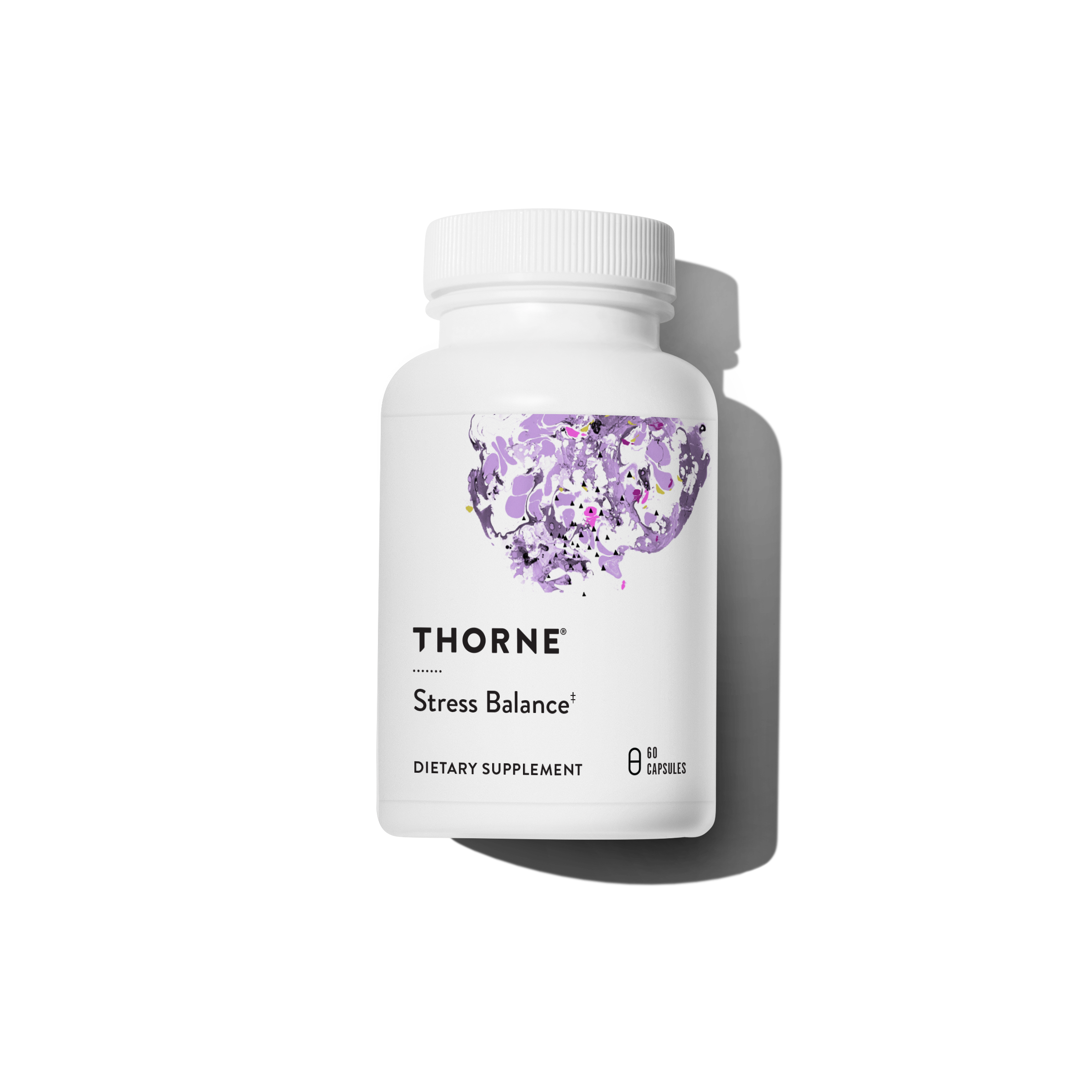
Thorne Stress Balance
KSM-66 ashwagandha + adaptogens + adrenal vitamins for cortisol & stress resilience
4.7/5 · 5,800+ reviews
- ✓KSM-66 ashwagandha — the most clinically researched extract for cortisol reduction
- ✓Combines Asian Ginseng, Eleuthero & Rhodiola for full adaptogen support
- ✓Includes adrenal-support vitamins B1, B5, B6, C & Zinc — Thorne quality, NSF Certified
#ad — I earn a small commission at no extra cost to you. I only recommend products I personally use.
Also Recommended
The 28-Day Cortisol Reset
A complete day-by-day protocol to reduce cortisol belly, fix the 3am wake-up, and restore energy naturally
See the 28-Day Cortisol Reset →Start here — just $17
The 7-Day Cortisol Belly Reset — Quick-Start Protocol
Everything in this post — the food framework, morning & evening routines, and 5 key supplements — organised into a focused 7-day plan. Instant PDF download.
Get Instant Access — $17 →
Sign 4: You feel wired but exhausted — especially in the afternoon
The 'tired but wired' feeling — exhausted but unable to relax, crashing in the afternoon but unable to sleep at night — is the subjective experience of a dysregulated cortisol curve. In a healthy cortisol rhythm, cortisol declines smoothly through the afternoon, reaching its lowest point in the evening. In HPA axis dysfunction, the curve becomes erratic: a high morning spike, a sharp mid-afternoon crash (the 2–3pm energy slump), and then a paradoxical evening rise that prevents sleep. This pattern drives both the belly fat accumulation and the fatigue, because chronically elevated cortisol suppresses thyroid function, disrupts insulin sensitivity, and depletes the neurotransmitters that regulate mood and motivation.
Sign 5: Calorie restriction makes it worse, not better
This is the most counterintuitive sign, and the one that causes the most frustration. Aggressive calorie restriction — particularly skipping meals, eating very low carbohydrate, or doing fasted cardio — triggers a cortisol response. Your body interprets food scarcity as a threat and releases cortisol to mobilise energy. For women with already-elevated cortisol, this additional spike compounds the problem and can actually increase visceral fat storage. If you've been eating less and exercising more for months with no change in your belly — or if your belly has gotten larger while the rest of you has gotten smaller — this is a strong signal that cortisol is the driver, not calories.
What actually works: addressing the root cause
The interventions that reduce cortisol belly are fundamentally different from those that reduce calorie-driven fat. The most evidence-backed approaches are: stabilising blood sugar (eating protein and fat at every meal, never skipping breakfast, avoiding refined carbohydrates in the morning), supporting the HPA axis with adaptogens — particularly KSM-66 ashwagandha, which has the strongest clinical evidence for cortisol reduction in perimenopausal women — and resetting the sleep-cortisol cycle by addressing the 3am wake-up pattern directly. Intense exercise, paradoxically, is often counterproductive in the early stages: it raises cortisol further. Walking, yoga, and strength training at moderate intensity are more effective for cortisol belly than HIIT.
If you want a structured 28-day protocol that addresses all four drivers of cortisol belly — blood sugar, sleep architecture, adaptogen support, and nervous system regulation — the [28-Day Cortisol Reset](/28-day-cortisol-reset) was built specifically for perimenopausal women navigating this pattern. It gives you one daily action to focus on, in the sequence that produces the fastest results.
You can also take the [Stress Level Assessment](/stress-level-calculator) to get a personalised picture of how cortisol is currently affecting your hormones and energy — it takes about three minutes and gives you a specific action plan based on your results.
This post contains affiliate links. I only recommend products I personally use and trust. This is not medical advice — always consult your healthcare provider before making changes to your supplement regimen, particularly if you have a pre-existing condition or are taking prescription medication.
From the researcher's desk
I built everything in this post into a focused 7-day protocol.
The 7-Day Cortisol Belly Reset covers blood sugar stabilisation, adaptogen timing, sleep architecture repair, and nervous system regulation — in one structured PDF you can start today.
Instant PDF download · 60-day money-back guarantee
Complete the 5-Part Cortisol Series
Signs → Diet → Exercise → Sleep → Reset. Each post builds on the last.

The Cortisol Diet: What to Eat to Lower Cortisol Naturally
8 min read

The Cortisol Exercise Plan: Why HIIT Makes Cortisol Belly Worse
8 min read

The Cortisol Sleep Protocol: Fix the Hormone That Wakes You at 3am
8 min read

How to Reset Your Cortisol in 7 Days: A Day-by-Day Guide
9 min read
Did this help? Share it with a friend 🌿
Did this help? Share it with a friend 🌿
Research & Sources
- Incollingo Rodriguez AC, Epel ES, White ML, Standen EC, Seckl JR, Tomiyama AJ Hypothalamic-pituitary-adrenal axis dysregulation and cortisol activity in obesity: A systematic review. Psychoneuroendocrinology. 2015;62:301-18, 2015. https://pubmed.ncbi.nlm.nih.gov/26356039/
- Moyer AE, Rodin J, Grilo CM, Cummings N, Larson LM, Rebuffé-Scrive M Stress-induced cortisol response and fat distribution in women. Obes Res. 1994;2(3):255-62, 1994. https://pubmed.ncbi.nlm.nih.gov/16353426/
- Hewagalamulage SD, Lee TK, Clarke IJ, Henry BA Stress, cortisol, and obesity: a role for cortisol responsiveness in identifying individuals prone to obesity. Domest Anim Endocrinol. 2016;56 Suppl:S112-20, 2016. https://pubmed.ncbi.nlm.nih.gov/27345309/
- Papadopoulos AS, Cleare AJ Hypothalamic-pituitary-adrenal axis dysfunction in chronic fatigue syndrome. Nat Rev Endocrinol. 2011;7(12):695-702, 2011. https://pubmed.ncbi.nlm.nih.gov/21946893/
More on Hormones